

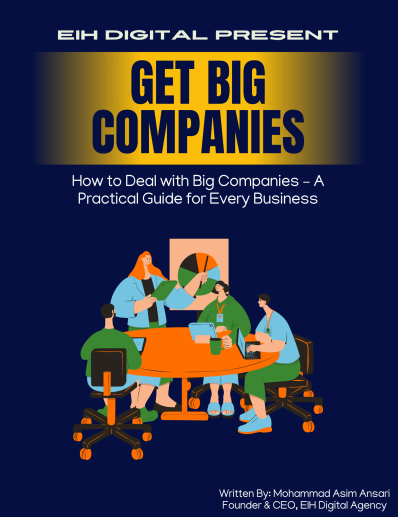
How to Deal with Big Companies: A Practical Guide for Every Business
Original price was: ₹999.00.₹149.00Current price is: ₹149.00.
Consistency and reliability are qualities big corporations value in a partnership. They need assurance that their partners will consistently deliver high-quality work on schedule. By demonstrating your commitment to quality and reliability, you can build trust with big companies and increase your chances of securing long-term partnerships.
In summary, understanding the corporate mindset is the first step to building successful relationships with large companies. By appreciating their focus on stability, brand protection, and long-term goals, you can better tailor your approach, demonstrating that you’re a reliable, risk-conscious partner.
Description
Understanding the Big Company Mindset
Working with large corporations can be both an intimidating and rewarding experience. If you’re a small business owner or an entrepreneur, understanding the mindset of a big company is essential to navigating this complex relationship successfully. Big companies have different priorities, structures, and processes than smaller businesses. Knowing how these corporations operate, their decision-making processes, and their internal goals can provide you with a significant advantage.
1. Big Company Priorities: Stability, Reputation, and Risk Management
Large corporations are driven by three main pillars: stability, reputation, and risk management. Unlike smaller businesses, they often avoid risks that could jeopardize their long-term stability and public image. This is why they can appear slow or cautious when considering new partnerships or products. They seek vendors or partners who can provide reliable, tested, and scalable solutions that won’t introduce potential risks.
Companies likeHostinger, known for their reliable and scalable web hosting services, have positioned themselves as dependable partners for large firms. By emphasizing security, customer satisfaction, and dependable performance, they resonate with big corporations seeking consistency.
2. The Decision-Making Process in Large Corporations
In big companies, decisions aren’t made on a whim. There are established procedures, departments to consult, and approval chains to navigate. This process can feel overwhelming, especially if you’re used to the faster pace of a smaller company. Decisions in large corporations typically require multiple rounds of discussion, testing, and validation across different departments. Patience is key.
Understanding that multiple stakeholders are often involved in each decision can help you tailor your approach. For example, a marketing decision might require input from finance, legal, and even compliance departments before a final commitment is made. This layered process ensures that all potential risks are assessed, making big companies feel secure in their choices. Solutions such asFiverr allow businesses to tap into talent pools that offer diverse skills, aligning with the corporate need for multifunctional solutions in project management.
3. Long-Term Focus and Strategic Goals
Another major factor in the corporate mindset is a focus on long-term goals. Large companies are structured to grow consistently over years and decades, not just for short-term gains. They look for partnerships that will support these objectives rather than quick wins. For this reason, they prefer working with partners who can demonstrate a history of growth, stability, and potential for future scaling.
For instance,Shopify is a great example of a platform that has built its reputation by supporting small and large businesses alike in achieving long-term e-commerce success. Shopify’s scalability and adaptability make it appealing to big corporations looking to future-proof their online business efforts.
4. Corporate Communication: The Language of Metrics
Data and metrics drive corporate decision-making. To resonate with a big company, you need to demonstrate how your product or service impacts their bottom line or strategic goals. Corporations prefer metrics that are quantifiable and directly tied to results, whether that’s cost savings, productivity increases, or customer satisfaction improvements.
Using tools likeSEMrush allows businesses to provide data-backed insights into market trends, competition, and customer behavior. Such platforms empower you to present your value proposition using real data, which resonates well with data-driven corporate clients.
5. Slow and Strategic Decision-Making
Big companies don’t often make hasty decisions, which can be frustrating if you’re used to a faster pace. Corporate decision-making is intentionally methodical because of the inherent risks involved. Changes or new partnerships could affect hundreds or thousands of employees, millions of customers, or even share prices. Therefore, they usually require thorough research, cross-departmental consultations, and input from various levels of management before moving forward.
For instance, before adopting a solution likeSentryPC, a corporate IT department might run tests, evaluate security impacts, and consider feedback from compliance officers to ensure it meets their rigorous standards. This thorough process minimizes risk but also means they take their time in finalizing decisions.
6. The Importance of Brand Image and Customer Trust
Brand image is everything for large corporations. Many of them have spent decades building a reputable brand, and one wrong move can undo years of hard work. This sensitivity to public perception often makes large corporations wary of working with smaller or lesser-known vendors. They want partners who understand the importance of brand reputation and are willing to go the extra mile to protect it.
One way to establish credibility in this area is by showing testimonials and case studies from satisfied clients. Platforms likeAppSumo allow small businesses to build credibility with customer reviews, which large companies appreciate when assessing new partners. Highlighting your past successes can help establish you as a trusted and reliable choice.
7. Risk-Aversion in Corporate Partnerships
Large companies tend to be risk-averse. Every decision is scrutinized because missteps can lead to regulatory issues, financial loss, or public backlash. This approach may be frustrating for smaller companies that are eager to make an impact quickly. However, understanding this mindset can help you align your proposal with the company’s concerns and showcase how your services minimize risk.
Small businesses that offer products likeUbersuggest use tools that allow corporations to gauge their risk by assessing current market trends, competition, and relevant data. When pitching to these companies, showing how your solution can lower risk and deliver measurable results makes you a more appealing option.
8. Building Trust Through Reliability and Consistency
Consistency and reliability are qualities big corporations value in a partnership. They need assurance that their partners will consistently deliver high-quality work on schedule. By demonstrating your commitment to quality and reliability, you can build trust with big companies and increase your chances of securing long-term partnerships.
In summary, understanding the corporate mindset is the first step to building successful relationships with large companies. By appreciating their focus on stability, brand protection, and long-term goals, you can better tailor your approach, demonstrating that you’re a reliable, risk-conscious partner.
Related products
- Sale!
- eBooks
Mastering Shopify – From Setup to Scaling a Global Brand
- Original price was: ₹999.00.₹149.00Current price is: ₹149.00.
- Add to cart
- Sale!
- eBooks
YouTube: Earn with Faceless Video
- Original price was: ₹999.00.₹149.00Current price is: ₹149.00.
- Add to cart
- Sale!
- eBooks
Affiliate Marketing – Your Ultimate Guide to Building a Profitable Affiliate Business.
- Original price was: ₹999.00.₹149.00Current price is: ₹149.00.
- Add to cart


Reviews
There are no reviews yet.